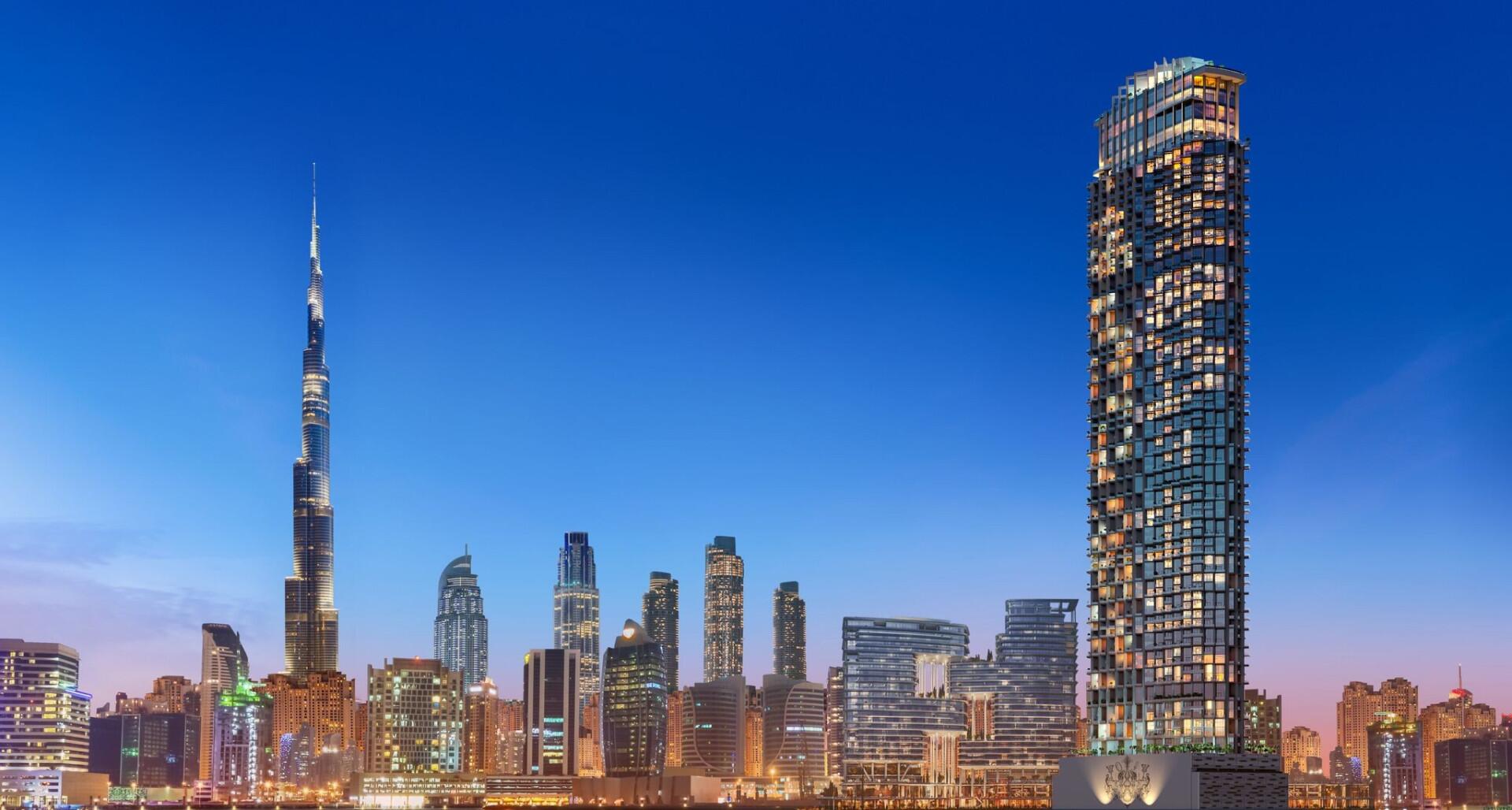
From the Burj Khalifa and the Burj Al Arab to the residential towers of Dubai Marina and the office buildings of DIFC, Dubai’s skyline reflects the city’s shift toward vertical, connected and mixed-use urban living.
How Dubai Became a Vertical City
Dubai’s modern skyline developed alongside the city’s rapid population and economic growth.
As more people moved to Dubai for work, business and investment, the city needed new homes, offices and commercial spaces. Building upwards allowed developers to accommodate more people and businesses in well-connected areas.
High-rise development became particularly visible in places such as Downtown Dubai, Dubai Marina, Business Bay and Jumeirah Lakes Towers.
However, the transformation was not simply about constructing taller buildings.
Many developments were planned as part of larger communities, with residential buildings located close to shops, restaurants, hotels, offices, transport links and leisure facilities. This helped create a style of urban living where people could access more of their daily needs within the same area.
Vertical living gradually became a normal part of life in Dubai.
How High-Rise Development Changed the Way People Live
Dubai’s towers helped shape expectations around modern city living.
High-rise living became an everyday choice
Apartment living at height is now a familiar part of Dubai’s residential market.
Many residential towers offer facilities such as swimming pools, gyms, parking and shared recreational areas. Their location can also place residents close to supermarkets, restaurants, cafés, public transport and other services.
Dubai Marina is a clear example. Residential towers sit around the marina and are connected to a wider network of restaurants, shops, hotels and pedestrian routes.
For residents, the appeal is not simply living on a higher floor. It is the combination of a private home with access to an active urban neighbourhood.
Mixed-use communities brought daily activities closer
Another major change has been the growth of mixed-use development.
Instead of separating homes, offices, shopping and leisure into completely different parts of the city, many Dubai developments bring these uses closer together.
Downtown Dubai is one of the best-known examples. The area around Burj Khalifa includes residential buildings, hotels, retail, restaurants, attractions and public spaces.
This creates a neighbourhood where different activities can happen within a relatively compact area.
The same idea can be seen in other parts of Dubai, although each district has its own character and mix of uses.
Waterfront living became part of the urban experience
Dubai’s high-rise developments also changed how residents interact with the waterfront.
Dubai Marina combines residential towers with a marina, promenade, restaurants, cafés, retail and leisure spaces. The waterfront is not simply something residents can see from their balconies. It is part of the neighbourhood itself.
This helped establish waterfront communities as an important part of Dubai’s residential landscape.
Burj Khalifa Put Vertical Development on a Global Stage
The Burj Khalifa is one of the clearest symbols of Dubai’s approach to vertical development.
Opened in 2010, the tower became the world’s tallest building and a defining landmark for Dubai. Its importance, however, goes beyond its record-breaking height.
The tower forms the centrepiece of Downtown Dubai, an area that combines residential buildings, hotels, retail, restaurants, entertainment and public spaces.
This created a different way of looking at a landmark skyscraper. Rather than functioning only as an isolated attraction, Burj Khalifa became part of a larger urban district where people live, work, shop, dine and spend their leisure time.
Its presence also helped give Downtown Dubai a strong identity that extends well beyond the building itself.
Burj Al Arab Made Architecture Part of Dubai’s Global Image
The Burj Al Arab had a different role in shaping Dubai.
Opened in 1999, the sail-shaped hotel quickly became one of the city’s most recognisable landmarks. Its distinctive design showed how architecture could become part of a destination’s identity.
Unlike residential towers that primarily influence how people live, the Burj Al Arab has had a stronger influence on Dubai’s image as a global tourism and hospitality destination.
It also contributed to a wider perception of Dubai as a city willing to use ambitious architecture to create recognisable landmarks.
Today, distinctive buildings remain an important part of Dubai’s visual identity.
Dubai Marina Changed the Idea of Waterfront Living
Dubai Marina is one of the clearest examples of high-rise development becoming part of a wider lifestyle destination.
The district combines residential towers with a man-made marina, waterfront walkways, restaurants, cafés, shops, hotels and leisure facilities.
This created a form of urban living where the waterfront is closely connected to everyday life.
Residents can live in a high-rise apartment while having access to walking routes, dining and leisure spaces around the marina.
The development also showed how high-density residential buildings can be combined with public and commercial spaces to create an active neighbourhood rather than a collection of standalone towers.
Towers Helped Shape Dubai’s Business Districts
Dubai’s vertical development is not limited to residential areas.
Business districts such as DIFC and Business Bay have developed around high-rise office buildings, with hotels, restaurants, retail, residences and other services nearby.
This has helped create business areas that remain active beyond traditional office hours.
DIFC, for example, has developed into an important financial and commercial district, while Business Bay combines offices, residences, hotels and commercial destinations along the Dubai Canal and surrounding streets.
For workers and visitors, this type of development can reduce the separation between the workplace and other parts of daily life.
For businesses, a recognisable address within a major commercial district can also become part of the company's presence in Dubai.
Dubai’s Towers Became Part of Everyday Life
Dubai’s most recognisable buildings may attract tourists, but their influence extends into everyday life.
Towers serve as homes, offices, hotels, retail destinations and landmarks. They are also used as reference points when people describe where they live, work or are meeting.
The Burj Khalifa is closely associated with Downtown Dubai. The towers surrounding Dubai Marina help define the area's waterfront character. The high-rises of DIFC form part of the visual identity of Dubai's financial district.
In this way, the skyline has become more than a collection of buildings. It has become part of how people understand and navigate the city.
Modern Dubai Is About More Than Building Tall
One of the biggest lessons from Dubai’s development is that successful urban living depends on more than the height of a building.
A tower can provide hundreds of homes or offices, but the surrounding area plays an important role in how people experience the city.
Access to roads, public transport, shops, restaurants, parks, schools, entertainment and public spaces can influence the appeal of a neighbourhood just as much as the building itself.
That is why some of Dubai’s most recognisable developments are better understood as parts of larger communities.
The tower may be what catches the eye first, but the neighbourhood around it is what turns the development into a place where people can live, work and spend their time.
What Dubai’s Skyline Says About Modern City Living
Dubai’s skyline reflects a broader change in how people think about urban living.
For many residents, choosing a home is not only about the size or design of the property. Location and access to everyday services can be equally important.
Being close to work, restaurants, shops, public transport, waterfront areas and leisure destinations can make a significant difference to daily routines.
Dubai’s development has brought many of these elements closer together, particularly in established high-rise districts.
The result is a city where vertical living and neighbourhood-based lifestyles have become closely connected.
Dubai’s Skyline Is Still Evolving
Dubai’s skyline continues to change as new communities and developments take shape.
The focus of modern development is increasingly broader than simply adding another tall building. New projects can combine residential properties with retail, hospitality, public spaces, waterfront areas, and other amenities.
This means Dubai’s future skyline will continue to reflect changes in how people want to live and use the city.
From the Burj Khalifa and Burj Al Arab to Dubai Marina, Downtown Dubai, Business Bay and DIFC, the city's most recognisable buildings have helped shape more than its appearance.
They have contributed to a style of urban living built around vertical homes, connected communities, mixed-use districts and access to a wide range of services and experiences.
Explore Dubai Real Estate with PSI
At Property Shop Investment, we follow the communities and developments shaping Dubai and the wider UAE property market.
Explore Dubai properties with PSI and discover the neighborhoods behind the city’s iconic skyline.